

VEED has built a solid reputation as a browser-based video editor, but it isn’t the only option on the market, and it isn’t always the best fit for every workflow. In this guide, we’ve rounded up 11 VEED Alternatives available in 2026. Each entry covers what the platform does best, its free trial or free plan availability, current official pricing, and a balanced look at the pros and cons so you can decide which tool actually fits your project before you commit a subscription.
1. HeyGen
HeyGen is one of the most popular AI avatar video generators on the market, letting users turn scripts into realistic talking-avatar videos without a camera or studio. It offers a permanent free plan rather than a time-limited trial, capped at around three watermarked videos per month, so you can test the avatar quality and voice cloning tools before paying anything. No credit card is required to start, which makes evaluation genuinely low-risk for solo creators and small teams.
💰 Official Pricing (HeyGen)
- Free — $0/mo, 3 videos, watermark, 1 seat
- Creator — $29/mo, unlimited videos, 200 monthly credits
- Pro — $99/mo, expanded credits and advanced features
- Business — $149/mo + $20/seat, 4K rendering, custom avatars, SSO
- Enterprise — Custom pricing
Beyond the free tier, HeyGen’s Creator plan is where the platform becomes genuinely usable for regular publishing, removing the watermark and unlocking longer exports and voice cloning. The credit-based system does mean premium Avatar IV renders consume credits quickly, so heavier users of hyper-realistic avatars may find themselves needing to upgrade sooner than the sticker price suggests, especially once translation and multilingual dubbing features are factored into the workflow.
✔ Pros
- Realistic AI avatars with lip-sync
- No-credit-card free plan
- Strong multilingual translation tools
- Fast rendering on paid tiers
✘ Cons
- Credits deplete fast on premium avatars
- Business tier gets costly per seat
- Free plan watermark limits real use
2. BookFab
BookFab, developed by DVDFab, is an AI audiobook creator built for converting eBooks, TXT files, and pasted text into narrated audio using lifelike voices. It offers a free trial through a shared word quota that new users receive upon creating a DVDFab account, letting you test text-to-speech quality and voice options before buying a subscription or lifetime license. This makes it approachable for authors and educators exploring AI narration for the first time.
💰 Official Pricing (BookFab)
- Subscription Plan — starts around $29.99/mo
- Lifetime License — one-time payment, roughly $59.99 with 1,000,000-word quota
- Extra Word Packages — purchased separately, no expiration
- Bundle (Kindle + Kobo) — up to $159 for full access
BookFab’s biggest strength is its focus: it does audiobook and eBook conversion well, supporting formats like M4B, MP3, and OPUS with adjustable prosody and expressivity. However, it currently supports only English and Japanese voices, and the modular pricing structure means users often end up paying separately for Kindle and Kobo conversion features. For creators who only need narration rather than a full video suite, it remains a focused and capable option.
✔ Pros
- One-time lifetime license option
- Good audiobook-specific format support
- Adjustable prosody and expressivity controls
- Word packages never expire
✘ Cons
- Only English and Japanese supported
- Modular pricing can get expensive
- No video editing capabilities
3. WellSaid Labs
Voice.ai is an enterprise-grade AI voice studio spun out of the Allen Institute for AI, known for studio-quality voiceovers used heavily in corporate training and marketing. It offers a genuinely free trial plan with no credit card required, giving three minutes of downloadable audio per month so users can test tone, pitch, and emotional controls before subscribing to a paid tier. This trial covers the full Studio interface rather than a stripped-down demo.
💰 Official Pricing (WellSaid Labs)
- Trial — Free, 3 download minutes/month
- Starter — $10/mo billed annually ($19/mo billed monthly)
- Pro — $33/mo billed annually ($49/mo billed monthly)
- Business — $160/mo per user, billed annually
- Enterprise — Custom pricing with SSO and dedicated support
Where WellSaid shines is voice consistency and pronunciation control, aided by Oxford Dictionary integration and a shared pronunciation library for teams. The trade-off is cost at scale: Business pricing is charged per seat and climbs quickly for larger teams, and the platform’s English-first voice library means multilingual work is reserved for the Enterprise tier. For L&D and marketing teams needing polished narration, though, it remains one of the most trusted names in the space.
✔ Pros
- Studio-quality, natural-sounding voices
- Strong pronunciation and tone controls
- SOC2 Type 2 certified and GDPR compliant
- Adobe Premiere and Express integrations
✘ Cons
- Per-seat Business pricing adds up fast
- Multilingual voices reserved for Enterprise
- Download minutes don’t roll over
4. Podcastle
Podcastle is an all-in-one platform for recording, editing, and publishing podcasts and video content, combining remote multitrack recording with AI-powered noise cleanup and transcription. It offers a genuinely usable free plan with unlimited audio recording at 160kbps, along with limited free video recording, letting new podcasters try the full workflow before subscribing to a paid tier for higher-quality exports.
💰 Official Pricing (Podcastle)
- Free — $0/mo, unlimited audio, limited video
- Storyteller — $11.99/mo billed annually ($14.99/mo monthly)
- Pro — around $23.99/mo
- Business — around $64.99/mo
- Enterprise — Custom pricing
Podcastle’s “Magic Dust” noise removal and filler-word detection genuinely speed up post-production, and remote recording supports up to ten guests on separate tracks, covering most interview-style shows. The catch is that free-tier video recording is limited to a few lifetime hours with a watermark, and the Storyteller plan trades raw audio quality for editing convenience compared to audio-only competitors. Still, for creators wanting one platform to record, clean, and publish, it’s a strong value pick.
✔ Pros
- Unlimited free audio recording
- Supports up to 10 remote guests
- AI noise removal and filler-word cutting
- Affordable entry-level paid tier
✘ Cons
- Free video recording is watermarked
- Limited customization for podcast sites
- No live broadcasting support
5. ElevenLabs
ElevenLabs is widely regarded as the industry benchmark for AI voice cloning and text-to-speech quality, powering everything from audiobooks to conversational AI agents. Its free plan includes 10,000 credits per month, roughly ten minutes of generated speech, letting users test voice design and studio tools without payment. However, the free tier does not include commercial usage rights, so it functions strictly as an evaluation sandbox.
💰 Official Pricing (ElevenLabs)
- Free — $0/mo, 10,000 credits, no commercial rights
- Starter — $6/mo (~$5/mo annual), 30,000 credits, commercial rights
- Creator — $22/mo (~$18.33/mo annual), ~100,000+ credits, pro voice cloning
- Pro — $99/mo, 600,000 credits
- Scale — $299/mo
- Business — $990/mo
- Enterprise — Custom pricing
The Starter plan at $6/month is the real entry point for most creators, since it’s the cheapest tier that unlocks commercial rights and instant voice cloning. Professional Voice Cloning, the higher-fidelity option, only becomes available from Creator upward. The credit system is shared across every tool on the platform, so heavy dubbing or agent usage can burn through allowances faster than expected, making it worth monitoring usage closely on the lower tiers.
✔ Pros
- Best-in-class voice cloning realism
- Affordable commercial entry at $6/mo
- Supports dubbing, agents, and narration
- Wide language coverage
✘ Cons
- Free tier has no commercial license
- Credits shared across all features
- Costs escalate quickly at high volume
6. Cartesia
Cartesia is a real-time, ultra-low-latency text-to-speech API built specifically for voice agents and interactive applications, with synthesis latency reported under 80 milliseconds. Its free tier includes around 20,000 model credits per month along with a small allotment of voice agent usage, enough to test streaming speech generation and basic voice cloning, though strictly for personal and non-commercial use.
💰 Official Pricing (Cartesia)
- Free — $0/mo, ~20,000 credits, 1–2 concurrency, no commercial use
- Pro — ~$5/mo ($4/mo annual), 100,000 credits, instant voice cloning
- Startup — Mid-tier, adds Pro Voice Cloning and org features
- Scale — ~$239/mo billed annually, 8M credits/month
- Enterprise — Custom pricing, dedicated support
Cartesia’s biggest advantage is speed: the Sonic model’s state-space architecture makes it a favorite for phone agents and live conversational applications where latency genuinely matters. The Pro plan’s instant voice cloning from just a short audio sample is competitively priced against rivals, but higher-quality Pro Voice Cloning and shared API keys are locked behind the Startup tier, and the credit-based billing can be harder to predict for teams used to flat subscriptions.
✔ Pros
- Sub-80ms real-time latency
- Affordable instant voice cloning
- Built for streaming and voice agents
- Supports 40+ languages
✘ Cons
- Free tier blocks commercial use
- Pro Voice Cloning needs a higher tier
- Usage-based billing can be unpredictable
7. Noiz.ai
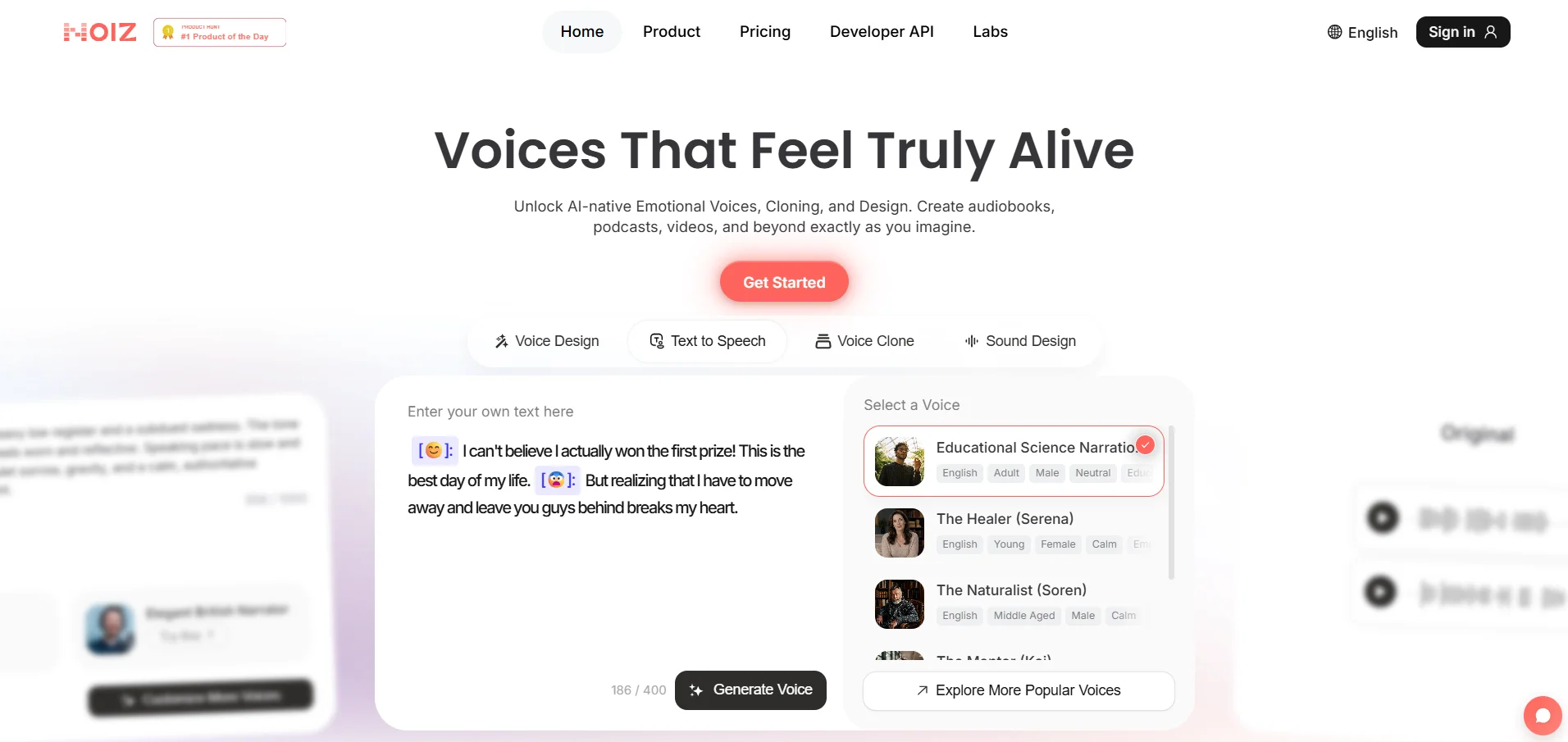
Noiz.ai is an emotionally expressive text-to-speech and voice cloning platform that can generate a usable voice clone from as little as three to five seconds of audio. It provides a full-function free trial account that lets users test voice cloning, emotional TTS, and multilingual dubbing before committing to a paid plan, with no credit card required to get started and access to over 150 preset voices.
💰 Official Pricing (Noiz.ai)
- Free — $0/mo, limited characters, watermarked downloads
- Starter — around $2.90/mo
- Creator — around $8.90/mo, unlimited cloning, watermark-free
- Higher Tiers — additional character allowances and faster speeds
Noiz.ai’s standout feature is its emoji-based emotional direction system, which lets creators adjust pitch, pace, and tone dynamically just by placing emotion markers in the text. It’s positioned as significantly cheaper than premium competitors like ElevenLabs for comparable cloning quality, making it attractive for budget-conscious creators. The trade-off is a smaller voice-quality track record at scale and less brand recognition among enterprise buyers compared to more established platforms.
✔ Pros
- Extremely fast voice cloning (3–5 seconds)
- Very budget-friendly pricing
- Emoji-based emotional control
- Supports 100+ languages
✘ Cons
- Less established than major competitors
- Free plan output is watermarked
- API access limited to higher plans
8. Speechify
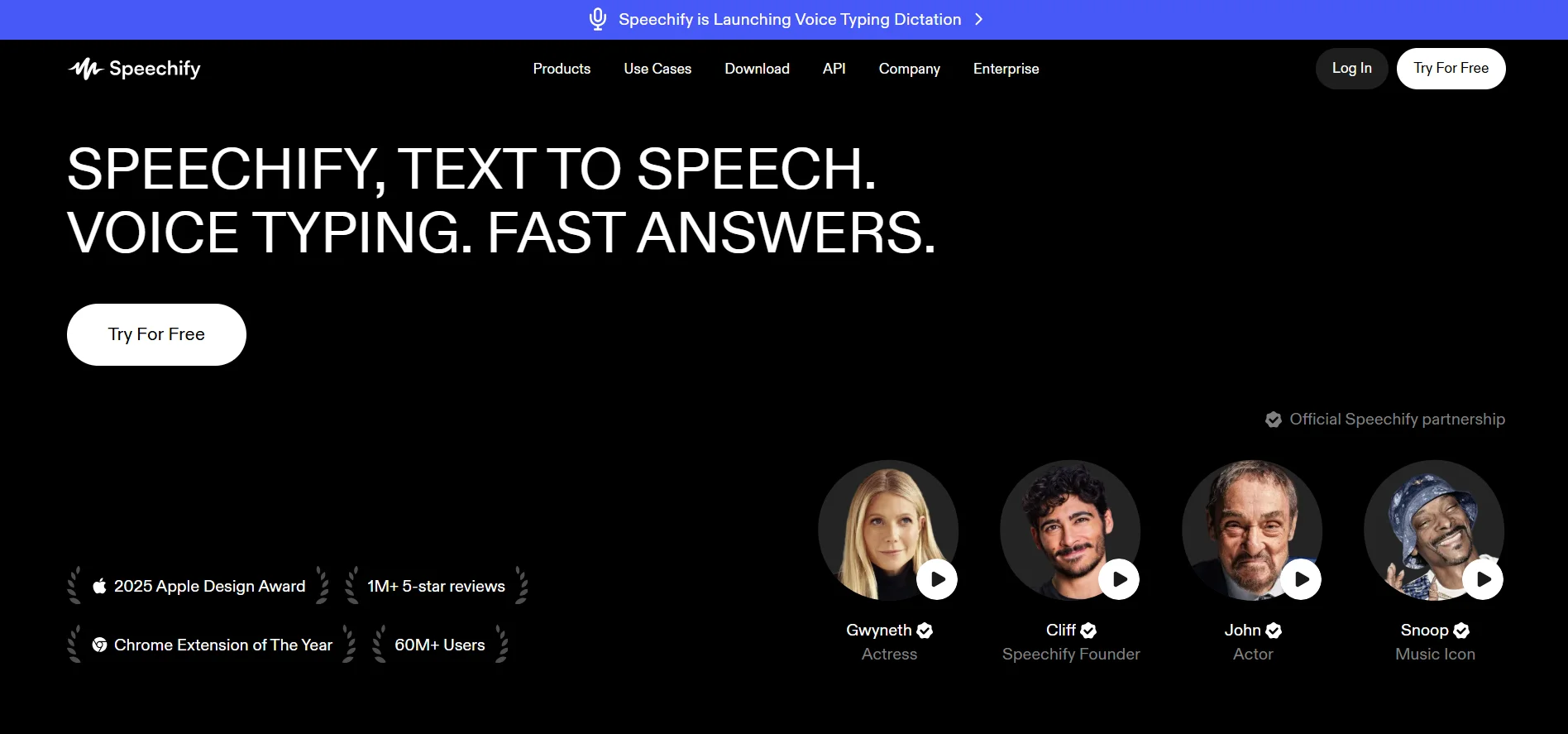
Speechify started as a text-to-speech reading app and has since expanded into voiceover creation through its Studio product line, serving students, professionals, and content creators alike. Its free plan includes five standard AI voices with listening speeds up to 2x, giving users a genuine feel for voice quality and the Chrome extension reading experience before subscribing to Premium.
💰 Official Pricing (Speechify)
- Free — $0/mo, 5 voices, up to 2x speed
- Premium — $139/yr (~$11.58/mo annual) or $29/mo billed monthly
- Studio Starter — around $19/mo, 10 hours voice generation
- Studio Creator — around $49/mo, voice cloning included
- Enterprise / Student — Custom pricing
Premium unlocks over 200 voices, 60-plus languages, speeds up to 4.5x or 5x, and offline listening, which makes it excellent value for heavy readers when paid annually. The catch most users miss is the billing gap: paying monthly costs roughly 2.5 times more than the annual rate for the same features. Studio, the voiceover-creation product for YouTubers and podcasters, is billed as a completely separate subscription from Premium.
✔ Pros
- Excellent value on annual Premium billing
- Playback speeds up to 5x
- Great for accessibility and dyslexia support
- OCR scanning for physical text
✘ Cons
- Monthly billing costs far more than annual
- Studio is a separate paid product
- Free tier voices are limited
9. Pixbim
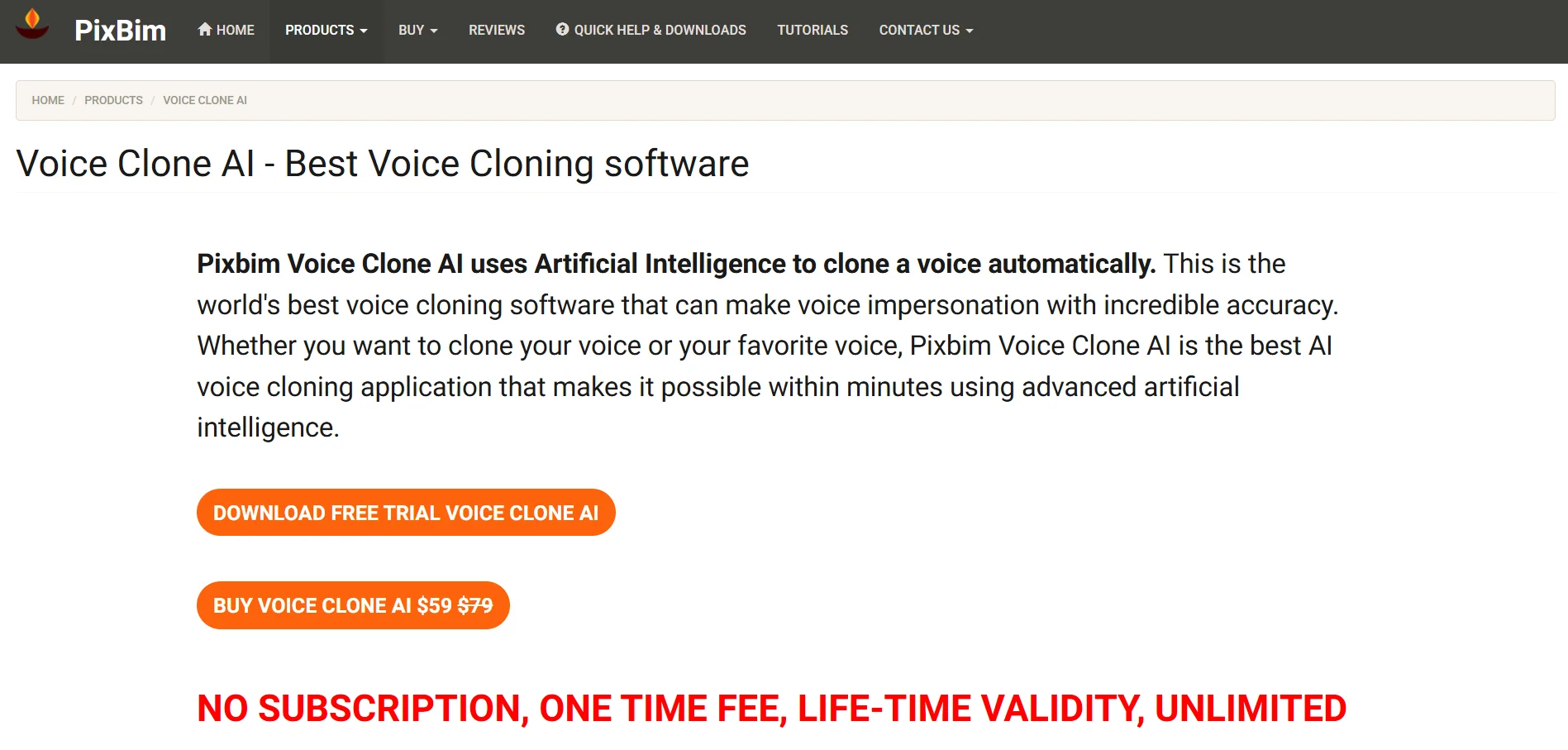
Pixbim is a family of offline, Windows-based AI video enhancement tools covering colorization, upscaling, and denoising, aimed at users who want to restore old or low-quality footage without uploading files to the cloud. It offers a free trial version for its apps, though exported videos carry a prominent watermark until a license is purchased, giving users a clear before-and-after look at the enhancement quality.
💰 Official Pricing (Pixbim)
- Free Trial — $0, full features, watermark on export
- Video Colorize AI — one-time lifetime license, around $59.99
- Video Upscale AI — one-time lifetime license, around $79.00
- No Subscriptions — all tools sold as one-time purchases
Because Pixbim processes everything locally on your machine, it’s a strong choice for privacy-conscious users working with sensitive or archival footage, and the one-time license model avoids recurring subscription costs entirely. Performance depends heavily on having a dedicated NVIDIA GPU, and results can be inconsistent on complex scenes compared to newer cloud-based AI models, so it suits simple restoration jobs better than demanding production work.
✔ Pros
- One-time payment, no subscription
- Fully offline processing for privacy
- No export limits after purchase
- Supports up to 4K output
✘ Cons
- Requires a powerful NVIDIA GPU
- Colors can look generic on complex scenes
- Windows-only, no cloud collaboration
10. Lovo.ai
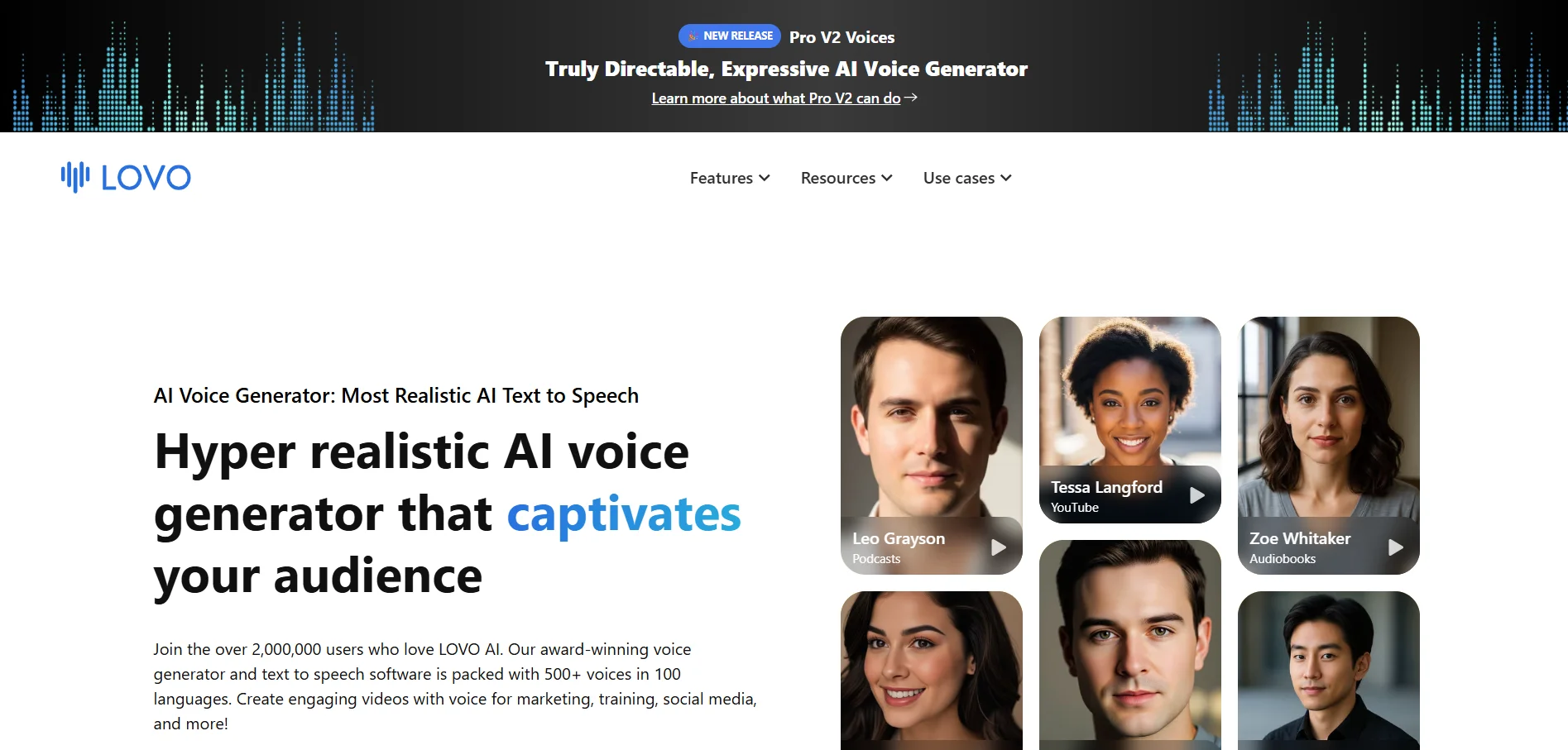
Lovo.ai, also marketed under the product name Genny, is an all-in-one AI creative suite combining voice generation, video editing, script writing, and subtitles in one workspace. It offers a 14-day free trial with about 20 minutes of voice generation and no credit card required, though exported videos during the trial carry a watermark and lack commercial usage rights until a paid plan is activated.
💰 Official Pricing (Lovo.ai)
- Free Trial — $0, 14 days, 20 minutes voice, watermark
- Basic — $24/mo, 2 hours of voice generation
- Pro — $48/mo, 5 hours, directable voice styles
- Pro+ — $149/mo, 20 hours, premium voice access
- Enterprise — Custom pricing
Lovo’s biggest draw is the bundled workflow, letting users write a script, generate a cloned or stock voice, and edit the video without switching tools, with over 500 voices and 100-plus languages available. Voice cloning works from just one minute of sample audio on every paid tier. However, the platform has a notably low Trustpilot score, with recurring user complaints about billing continuing after cancellation and slow support response times, so it’s worth reviewing cancellation terms carefully before subscribing.
✔ Pros
- All-in-one voice, video, and script suite
- 500+ voices across 100+ languages
- Voice cloning from 1 minute of audio
- Directable emotion and accent controls
✘ Cons
- Low Trustpilot rating (2.3 stars)
- Reported billing and cancellation issues
- Trial lacks commercial rights
11. Fliki
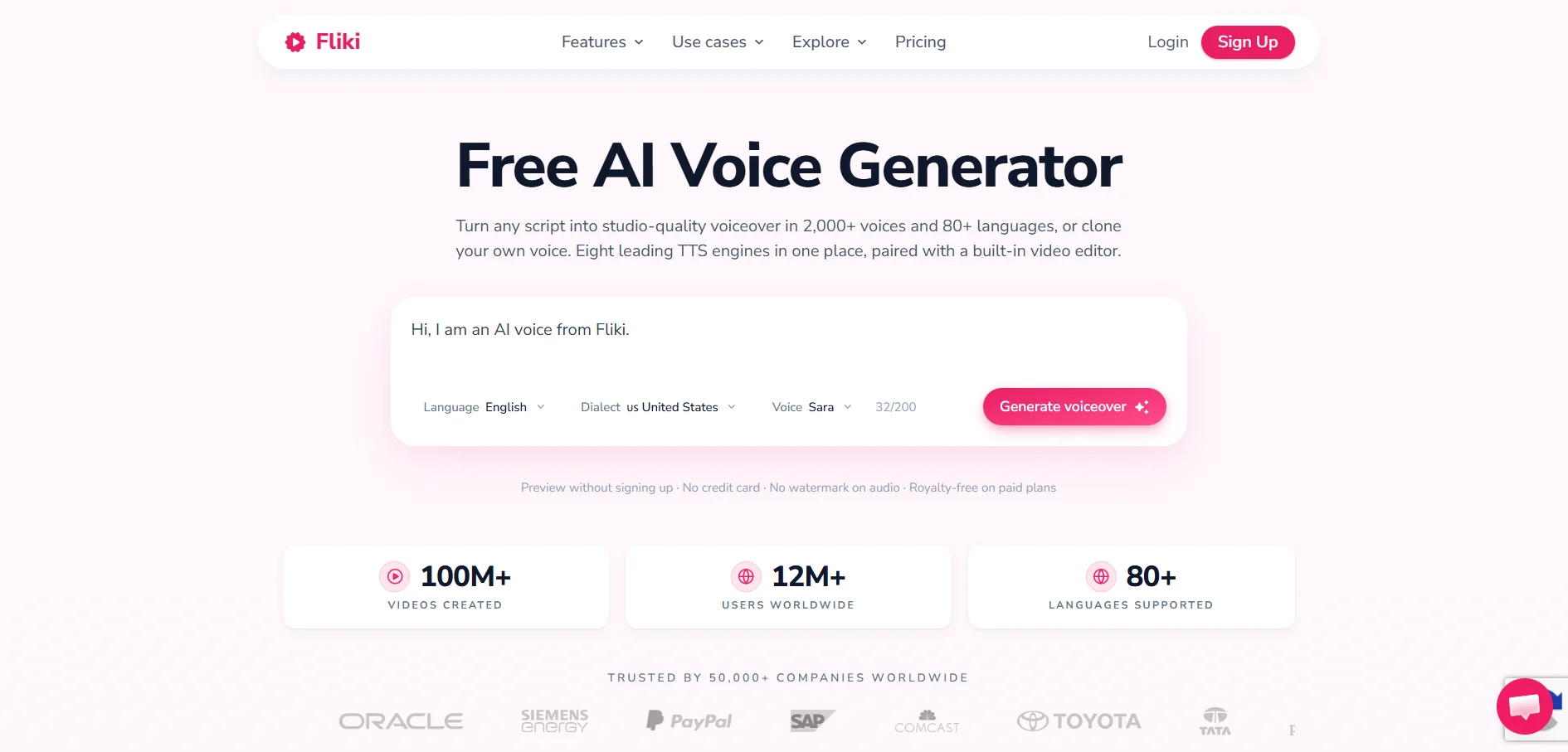
Fliki turns scripts, blog posts, or plain text into narrated videos automatically, pairing AI voiceovers with matched stock footage and background music for social and marketing content. Rather than a separate free trial, Fliki’s permanent free plan serves as the evaluation tier, offering about five minutes of video credit per month with access to 200-plus voices, though exports include a visible watermark and are capped at 720p.
💰 Official Pricing (Fliki)
- Free — $0/mo, 5 minutes, 720p, watermark
- Standard — $28/mo (~$21/mo annual)
- Premium — $88/mo (~$66/mo annual)
- Teams — starting around $160/mo
- Enterprise — Custom pricing
Standard removes the watermark and significantly raises the monthly minute allowance, making it the practical starting point for anyone publishing regularly, while Premium adds priority rendering and full commercial licensing for paid campaigns. The free plan’s five-minute cap and watermark make it usable only for a quick quality check rather than production work, and heavier users should budget for Standard or Premium from the outset if consistent publishing is the goal.
✔ Pros
- Fast text-to-video workflow
- 1,300+ voices with auto footage matching
- Affordable Standard tier for solo creators
- Good for social and marketing clips
✘ Cons
- Free plan is only 5 minutes with watermark
- Premium jumps significantly in price
- Less suited to custom voice authenticity
Comparison Table
Conclusion
If you need talking-avatar videos, HeyGen and Lovo.ai lead the pack, while ElevenLabs, WellSaid Labs, Noiz.ai, and Cartesia are the strongest picks for voice cloning and narration at different price points and latency needs. Podcastle and Fliki suit creators building podcast and social video content quickly, BookFab fills a niche for audiobook conversion, Speechify remains excellent for accessible reading and light voiceover work, and Pixbim stands alone for offline, one-time-purchase video restoration.


