

ChatGPT is a strong general-purpose assistant, but writers, novelists, and screenwriters often need tools built specifically for storytelling, formatting, and creative structure. From AI-powered screenplay software to novel-writing assistants and marketing copy generators, the tools below are designed to handle tasks that ChatGPT was never purpose-built for. This article has 11 popular ChatGPT Alternatives, covering their free trials, current pricing plans pulled from official sources, and the pros and cons of each.
Whether you are drafting a screenplay, writing a novel, or producing marketing content, one of these platforms is likely a better fit for your specific workflow.
1. Mugafi

Mugafi offers a free tier to get started, letting new users explore its AI co-writing and script development tools before committing to a paid plan. Paid subscriptions unlock deeper AI assistance, mentor feedback, and collaboration features, with exact tier pricing available on Mugafi’s official site depending on usage volume and feature access.
Pricing Overview:
- Free tier available with limited AI credits
- Paid plans unlock expanded AI writing, feedback, and formatting tools
- Enterprise/studio pricing available on request
Built specifically for screenwriters and IP creators, Mugafi combines AI writing support with human mentor feedback and a community marketplace. It targets storytellers in India, Southeast Asia, and the MENA region, aiming to make script development more accessible without needing a background in professional screenwriting or formatting.
The platform also includes plagiarism checks, dialogue consistency tools, and script quality scoring. Its blockchain-based IP tracking is a distinctive feature, allowing writers to establish ownership of their scripts and pursue licensing opportunities. This makes Mugafi more than a writing tool; it positions itself as an end-to-end IP creation ecosystem.
Pros
- Free tier available for beginners
- Human mentor feedback included
- Built-in IP and royalty tracking
Cons
- Smaller user base than major competitors
- Best suited for scripts, not novels
- Feature depth varies by plan
2. Powtoon AI Script Writer

Powtoon offers a free trial that allows users to test its AI script writer alongside its animated video builder before subscribing. Paid plans are tiered by video length, storage, and export quality, with pricing listed transparently on Powtoon’s official pricing page for individuals, teams, and businesses.
Pricing Overview (approximate, per Powtoon’s official site):
- Free plan: limited exports, watermarked videos
- Pro plan: roughly $19–$41/month billed annually
- Business/Agency plans: custom pricing for teams
Powtoon’s AI Script Writer is aimed at marketers and educators who need scripts for explainer videos, presentations, and animated content. Rather than writing prose or screenplays, it generates short, structured scripts optimized for voiceover pacing and visual storytelling within Powtoon’s animation editor.
The tool integrates directly into Powtoon’s video timeline, so a generated script can be turned into a full animated video without switching platforms. This makes it a strong choice for content creators who need fast video scripts rather than long-form fiction or screenplay-standard formatting.
Pros
- Seamless integration with video creation
- Good for short marketing/explainer scripts
- Free trial available
Cons
- Not designed for novels or screenplays
- Limited creative depth compared to fiction tools
- Paid tiers needed for full export quality
3. StoryCraft AI

StoryCraft AI typically offers a free trial or limited free tier so writers can test its plot-generation and character-building tools before upgrading. Paid subscriptions are usually structured around monthly credits or word counts, with pricing details available directly on the platform’s official website.
Pricing Overview:
- Free trial or limited free plan for new users
- Monthly subscriptions typically range from $10–$30/month
- Higher tiers unlock more generations and export options
StoryCraft AI focuses on helping fiction writers overcome blank-page paralysis by generating plot outlines, character arcs, and world-building details. It is designed for novelists and short-story writers who want structured assistance without losing creative control over the final prose.
Unlike general chatbots, StoryCraft AI keeps context across a project, remembering characters and plot threads as the story develops. This continuity makes it more useful for long-form fiction than ChatGPT, which requires writers to manually re-supply story context in each session.
Pros
- Maintains story and character continuity
- Good for outlining and brainstorming
- Affordable entry-level pricing
Cons
- Smaller community and support base
- Limited advanced formatting tools
- Credit limits can restrict heavy users
4. Sudowrite
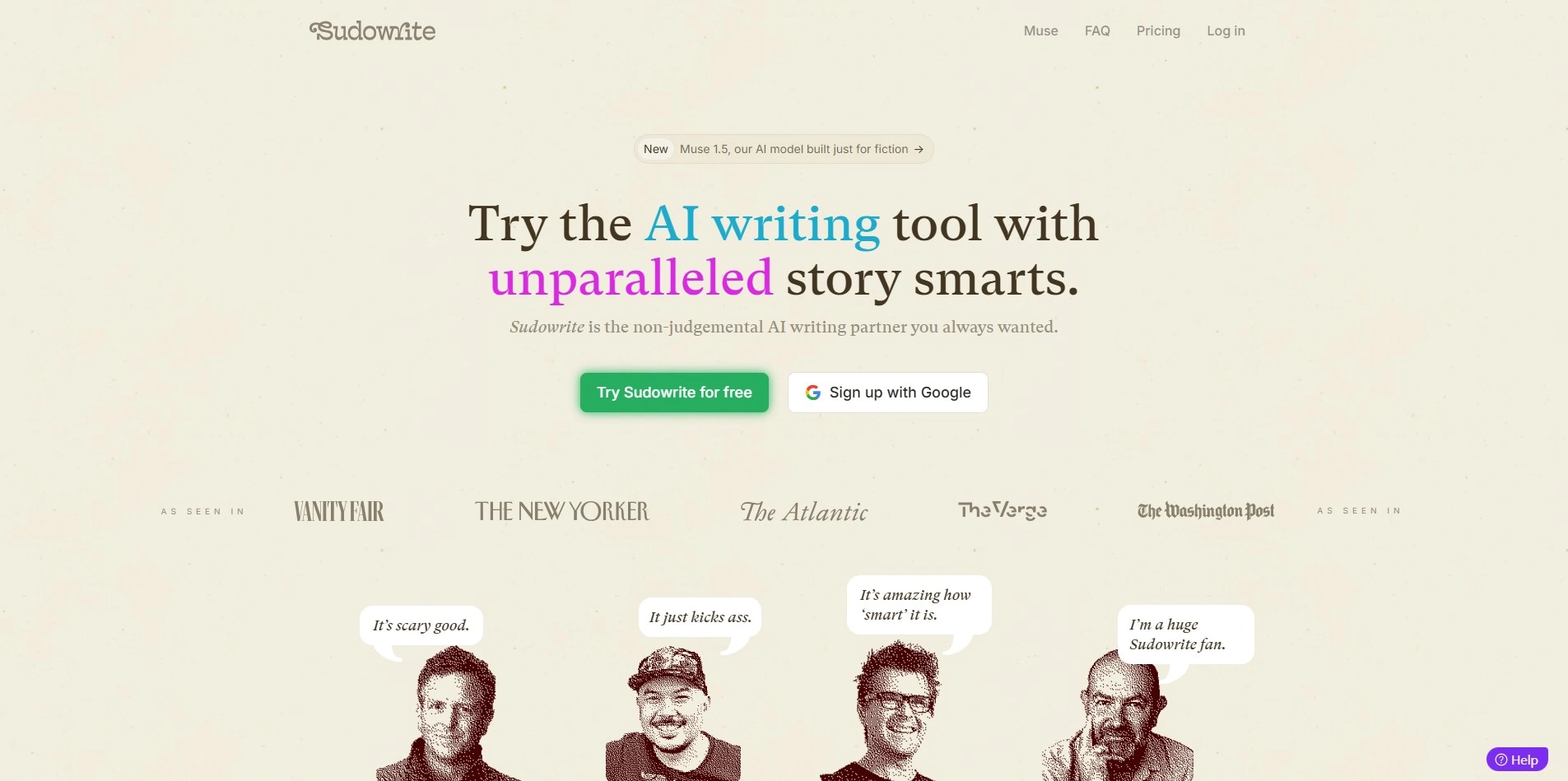
Sudowrite provides a free trial of roughly 10,000 credits with no credit card required, letting new users test its fiction-focused AI tools. According to Sudowrite’s official pricing page, paid plans are Hobby & Student at $10/mo (annual) or $19/mo (monthly), Professional at $22/mo (annual) or $29/mo (monthly), and Max at $44/mo (annual) or $59/mo (monthly).
Official Pricing (Sudowrite.com):
- Hobby & Student: $10/mo annual · $19/mo monthly — 225,000 credits
- Professional: $22/mo annual · $29/mo monthly — 1,000,000 credits
- Max: $44/mo annual · $59/mo monthly — 2,000,000 rollover credits
Sudowrite is built specifically for fiction writers, offering tools like Story Engine, Describe, Brainstorm, and Rewrite that help authors expand scenes, generate sensory detail, and beat writer’s block. All plans include the same feature set, differing only in monthly credit allowances.
Because credit consumption varies by feature and AI model chosen, costs can be unpredictable for heavy users, and unused credits expire on the Hobby and Professional tiers. Still, Sudowrite remains one of the most novelist-friendly AI writing tools on the market, especially for drafting and revising long fiction manuscripts.
Pros
- Purpose-built for fiction writing
- Free trial with no credit card required
- Story Engine keeps plot and character context
Cons
- Credit costs are unpredictable per feature
- No permanent free plan
- Credits expire on lower tiers
5. Dabble
Dabble offers a 14-day free trial so writers can test its novel-writing and organization features before subscribing. Paid plans are tiered by feature access, typically including a Basic plan, a Premium plan, and a top “DabbleU” bundle, with current pricing published on Dabble’s official website.
Pricing Overview:
- 14-day free trial, no credit card required
- Basic plan: roughly $10/month
- Premium plan: roughly $20/month with added tools and courses
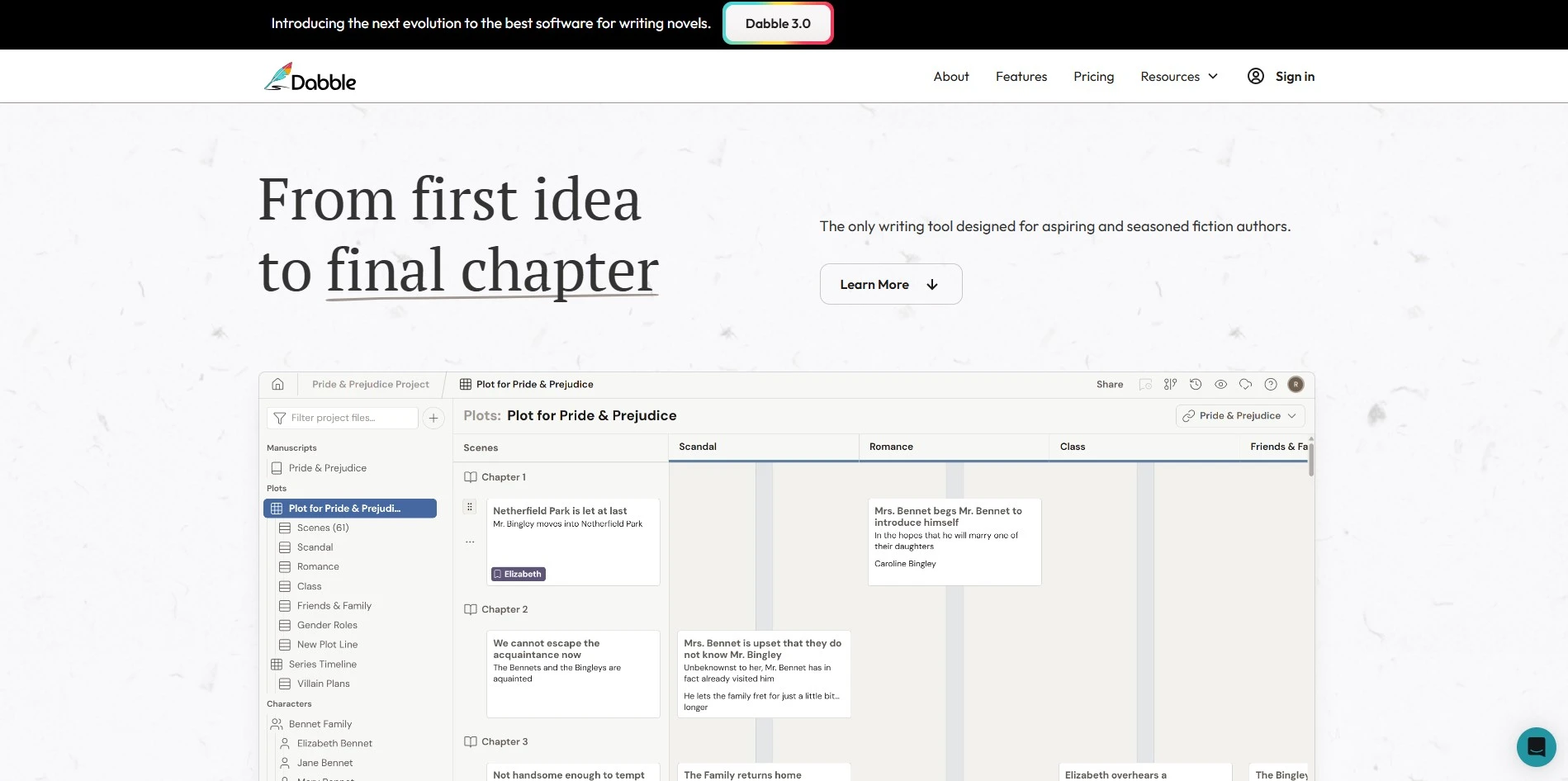
Dabble is a novel-writing platform rather than a pure AI chatbot, combining a distraction-free editor with plotting boards, character profiles, and a built-in AI writing assistant called DabbleGPT. It focuses on organization as much as generation, appealing to writers who plan extensively before drafting.
Its plot grid and story notes features let novelists visually track subplots, timelines, and character arcs alongside the manuscript. This structural focus makes Dabble a strong choice for writers managing complex, multi-character novels rather than short-form content.
Pros
- Strong plotting and organization tools
- 14-day free trial available
- Clean, distraction-free writing interface
Cons
- AI features are less powerful than dedicated AI tools
- Primarily useful for novel-length fiction
- Learning curve for new users
6. Storyflow
Storyflow typically provides a free trial or free-tier access so writers can explore its AI writing and story-mapping features before subscribing. Paid subscriptions are generally offered as monthly or annual plans, with pricing tiers listed on the platform’s official website based on feature access and word limits.
Pricing Overview:
- Free trial or limited free plan available
- Monthly plans typically range from $12–$35/month
- Annual billing usually offers a discount
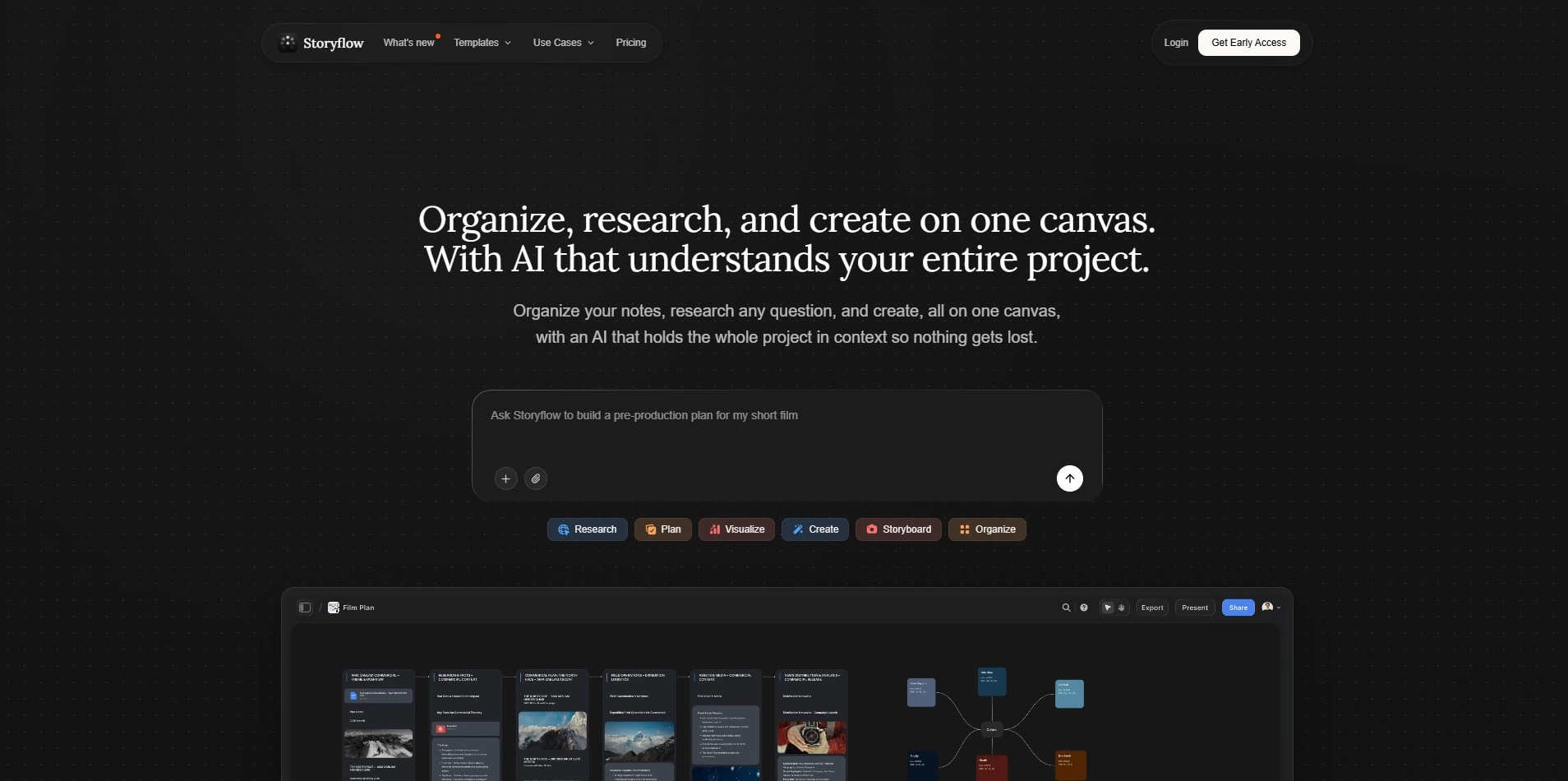
Storyflow is designed to help writers visually map out narrative structure while using AI to fill in scenes, dialogue, and transitions. It blends outlining tools with generative writing assistance, making it useful for both planners and writers who prefer to discover their story as they draft.
The platform’s visual story-mapping canvas sets it apart from text-only tools like ChatGPT, letting writers see their narrative arc at a glance. This can be especially helpful for screenwriters and novelists juggling multiple storylines or nonlinear timelines.
Pros
- Visual story-mapping canvas
- Good for both planners and pantsers
- Free trial available
Cons
- Less established than major competitors
- Feature set still evolving
- Limited third-party integrations
7. Arc Studio Pro
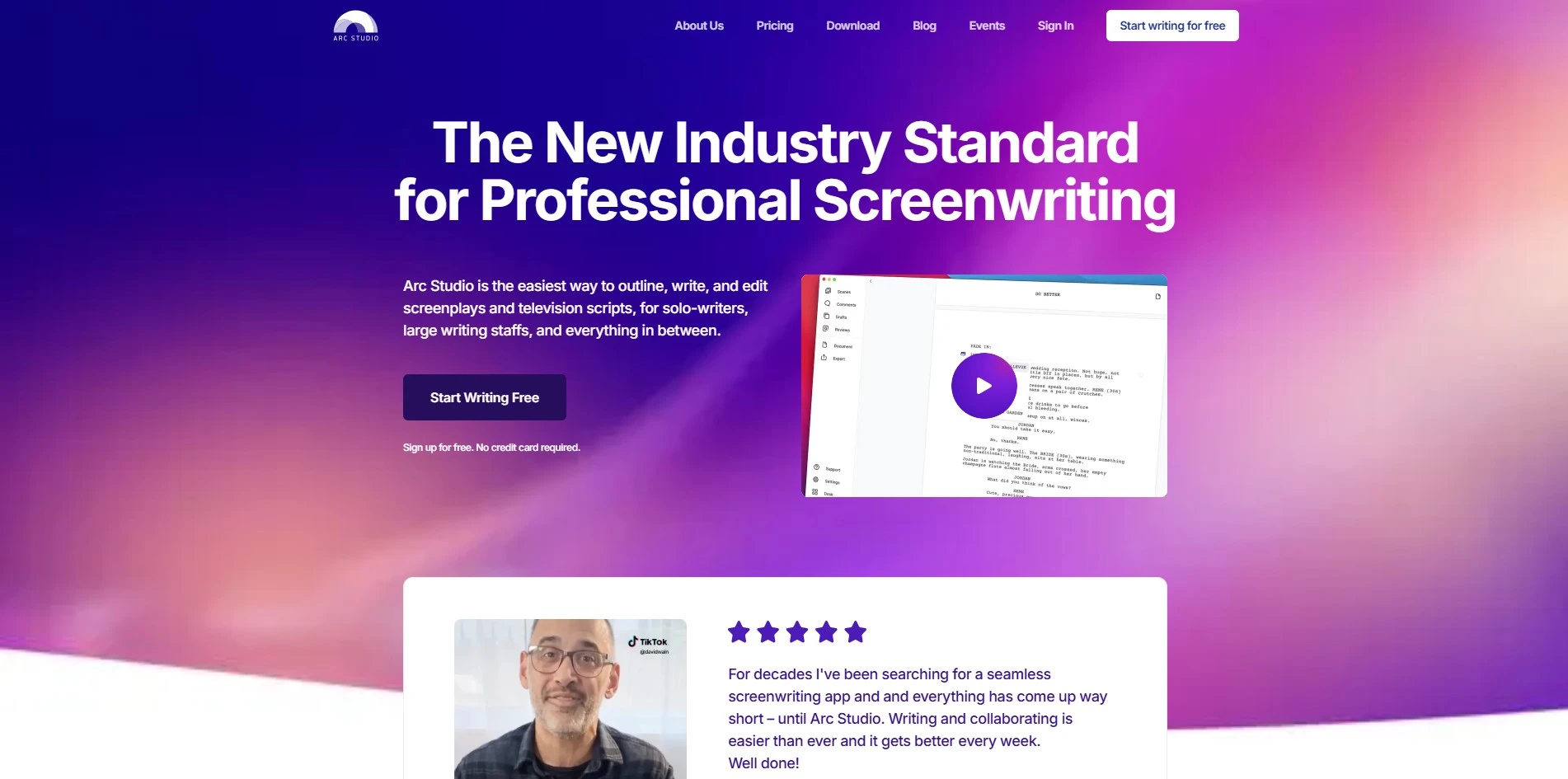
Arc Studio Pro offers a generous free plan, and users don’t need to provide credit card details to start writing. Its Pro tier is offered as affordable pay-as-you-go pricing rather than a rigid subscription, with current rates listed on Arc Studio Pro’s official pricing page.
Pricing Overview (ArcStudioPro.com):
- Free plan: full screenwriting features with limits
- Pro plan: pay-as-you-go, roughly $10–$15/month equivalent
- No credit card required to start
Arc Studio Pro is a modern, cloud-based screenwriting tool designed specifically for film and TV writers. It offers a distraction-free writing environment, industry-standard formatting, and collaborative features that let writers’ rooms work on the same script simultaneously in real time.
Distinct features include auto-completion technology for faster formatting, revision tracking, and automatic cloud and local backups so scripts are never lost. Its clean interface and screenwriting-specific shortcuts make it a favorite among independent screenwriters transitioning away from older desktop software.
Pros
- Generous free plan with no credit card needed
- Real-time collaboration for writers’ rooms
- Automatic backup and revision tracking
Cons
- Screenplay-only; not suited for novels
- Some advanced features gated behind Pro
- Smaller industry footprint than Final Draft
8. Final Draft
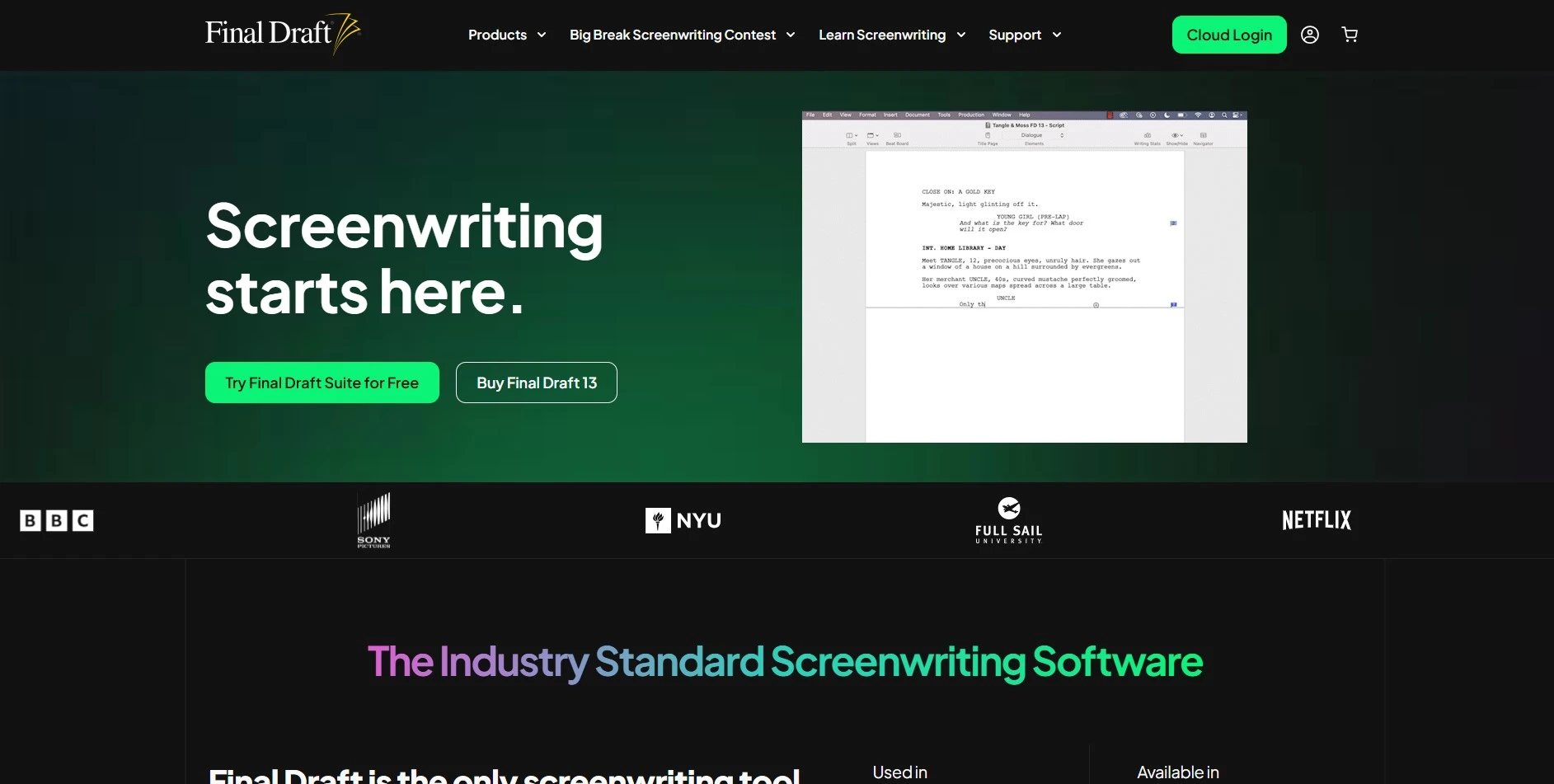
Final Draft offers a free trial through its official site so screenwriters can test the industry-standard formatting tools before purchasing. According to Final Draft’s official pricing page, Final Draft 13 costs a one-time $199.99 (currently 20% off from $249.99), while the Final Draft Suite subscription starts as low as $8.33/month billed yearly.
Official Pricing (FinalDraft.com):
- Final Draft Suite: from $8.33/month, billed yearly
- Final Draft 13 (one-time): $199.99 (20% off $249.99)
- Student Edition: $99.99 one-time (23% off)
- Studio/Education licensing: custom volume pricing
Final Draft is used by roughly 95% of film and TV professionals, making it the long-standing industry standard for screenplay formatting. It offers a Beat Board for outlining, ScriptNotes for flagging feedback across drafts, and speech-to-script dictation for faster drafting sessions.
Its combination of a one-time desktop purchase and an optional cloud subscription gives writers flexibility depending on whether they need offline access or collaborative cloud editing. This dual model is uncommon among modern AI writing tools, most of which rely entirely on subscriptions.
Pros
- Industry-standard, widely recognized format
- One-time purchase option available
- Trusted by professional studios and writers
Cons
- Higher upfront cost than newer competitors
- Interface feels dated compared to Arc Studio Pro
- Cloud features require a separate subscription
9. Squibler
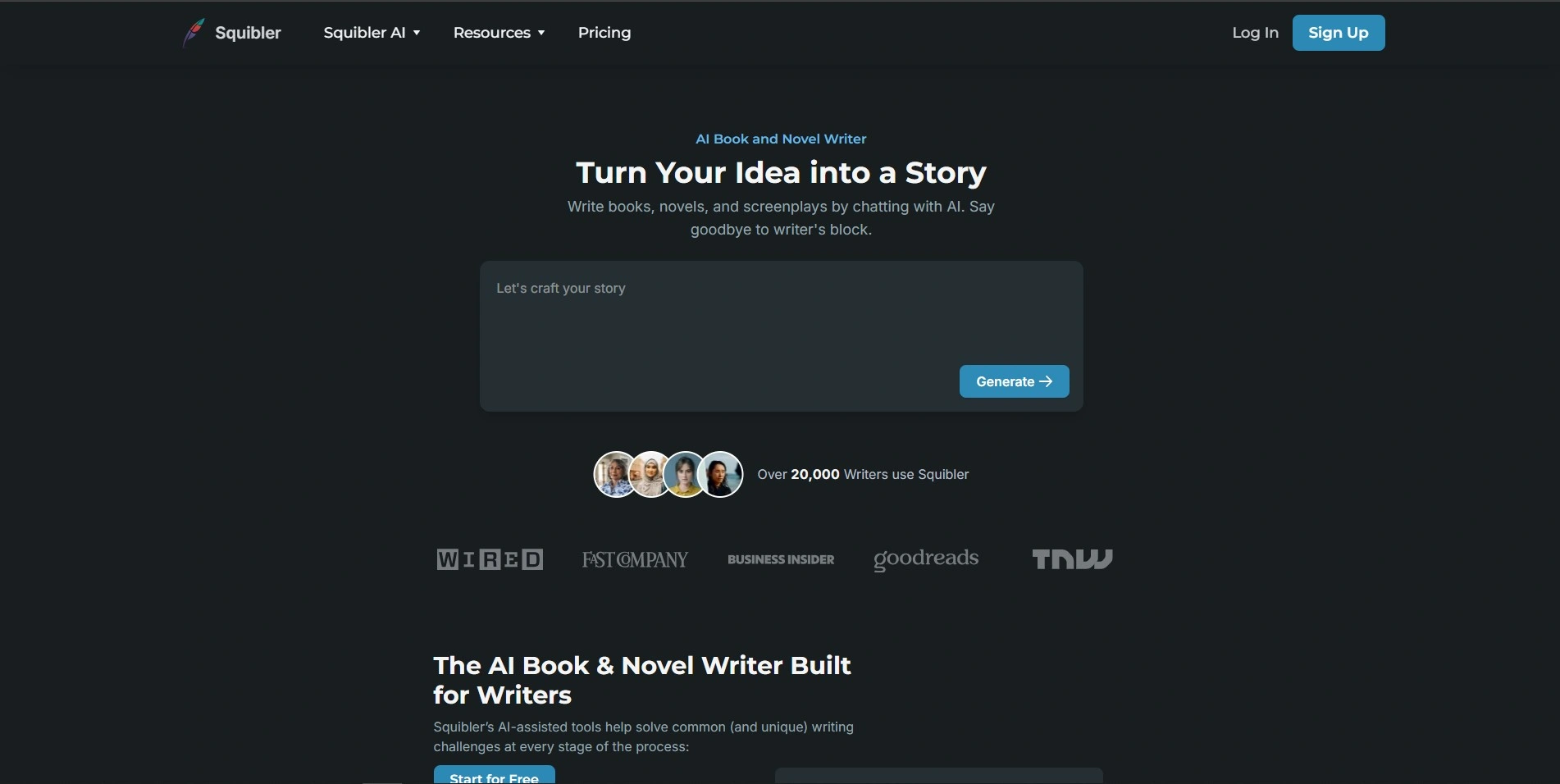
Squibler offers a free trial so writers can test its distraction-free editor and AI writing assistant before subscribing. Pricing plans, listed on Squibler’s official pricing page, are typically structured into a Free plan, a Pro monthly plan, and a discounted annual plan for long-term users.
Pricing Overview:
- Free plan with limited AI usage
- Pro plan: roughly $19.99/month billed monthly
- Annual plan: discounted rate, roughly $9.99–$12/month
Squibler positions itself as a flexible writing tool for novelists, screenwriters, and content creators, combining a customizable text editor with story-structure templates like the Hero’s Journey and Save the Cat. Its AI assistant helps with brainstorming, outlining, and overcoming writer’s block.
Unlike single-purpose tools, Squibler supports multiple document formats within one platform, letting users switch between novel manuscripts, screenplays, and non-fiction outlines. This versatility makes it appealing to writers who work across different formats rather than specializing in just one.
Pros
- Supports multiple writing formats in one tool
- Built-in story structure templates
- Free trial and affordable annual pricing
Cons
- AI features less advanced than Sudowrite
- Interface can feel cluttered for beginners
- Screenplay formatting less robust than Final Draft
10. Jasper AI
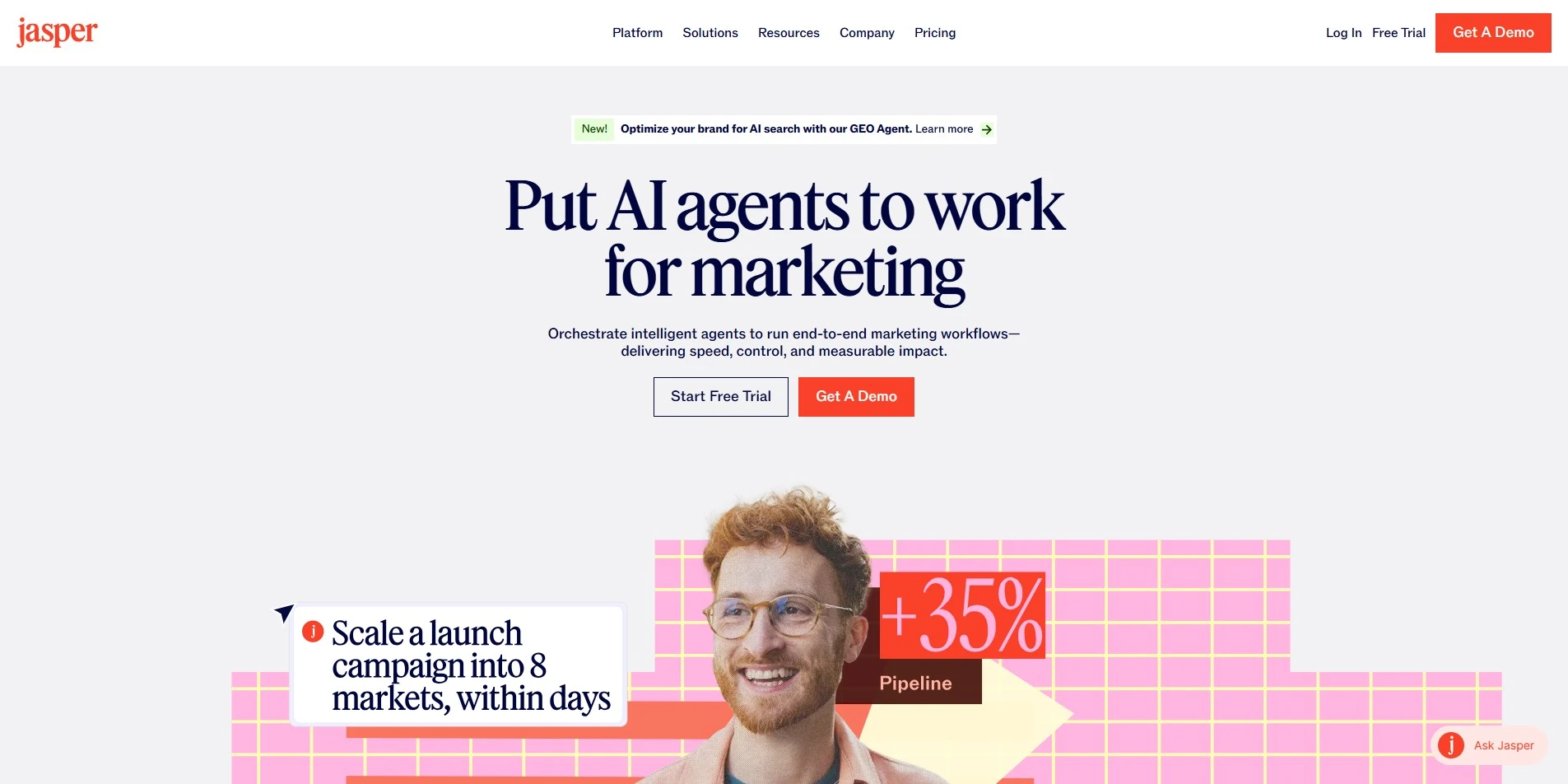
Jasper AI offers a 7-day free trial on its Pro plan, though a credit card is required and it converts to a paid subscription automatically. Per Jasper’s official pricing page, the Pro plan costs $69/month billed monthly or about $59/month billed annually, while Business plans use custom pricing for larger teams.
Official Pricing (Jasper.ai):
- Pro plan: $59/month (annual) · $69/month (monthly) — 1 seat, Canvas, Essential Apps
- Business plan: custom pricing, typically starting around $900+/month for teams
- No permanent free plan
Jasper AI has evolved from a blog-writing assistant into a full marketing content hub, offering brand voice training, SEO-focused content tools, and Chrome extension integration. It’s built primarily for marketers, agencies, and content teams rather than fiction writers or screenwriters.
Its Business plan adds unlimited seats, API access, and admin controls, making it scalable for larger organizations. However, its seat-based pricing and reliance on add-ons like Surfer SEO mean real costs can climb quickly for growing teams compared to its advertised starting price.
Pros
- Strong brand voice and SEO content tools
- Scalable for marketing teams and agencies
- Chrome extension for on-the-go writing
Cons
- No permanent free plan
- Pricier than most fiction-focused competitors
- Hidden costs from add-ons and seat scaling
11. Beemgee
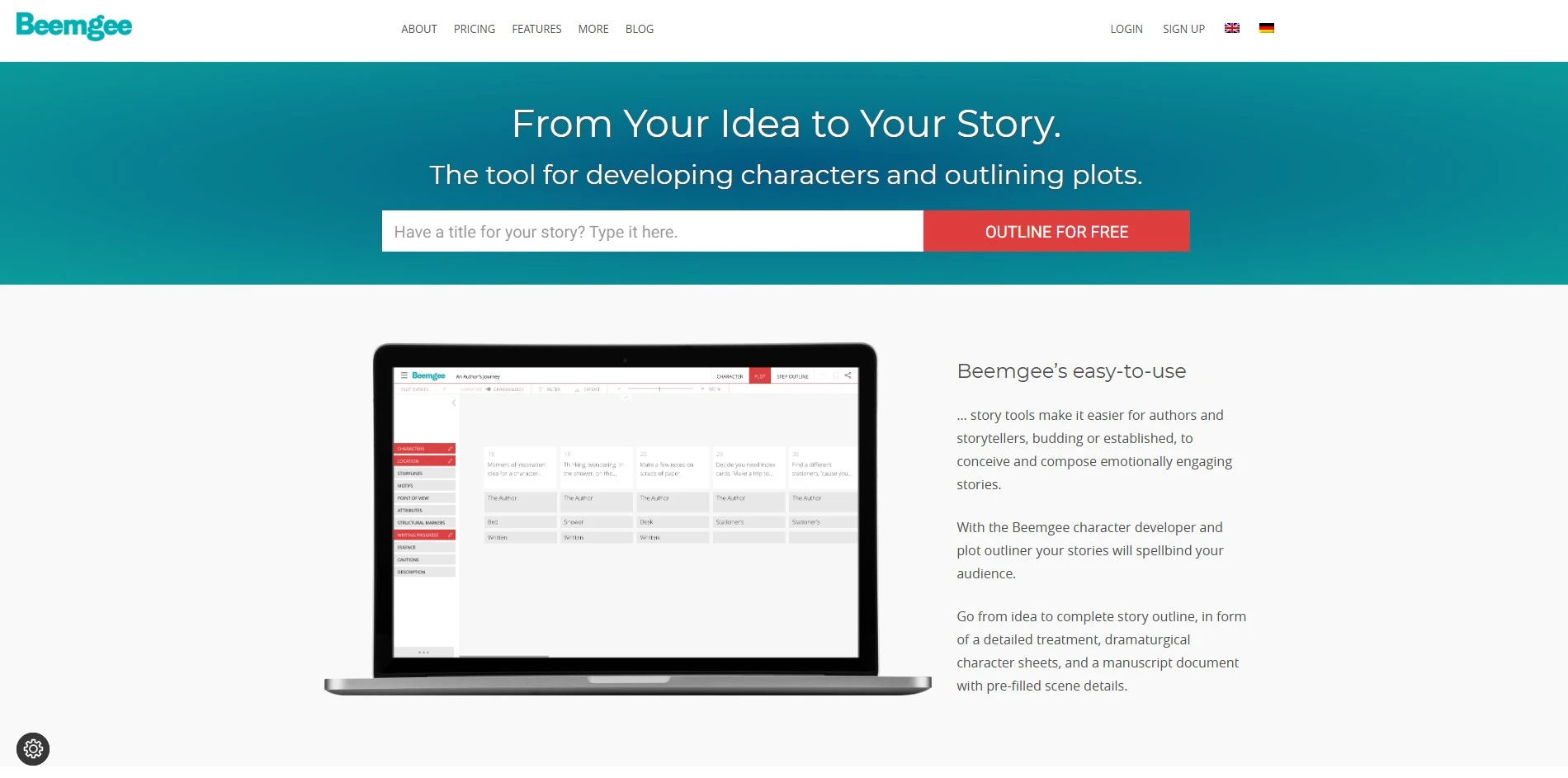
Beemgee offers a free plan with core outlining features, letting writers test its story-structuring tools before upgrading. Paid plans are typically offered as monthly or annual subscriptions, with current pricing tiers listed on Beemgee’s official website based on project limits and export options.
Pricing Overview:
- Free plan with limited projects and export options
- Paid plans: roughly $8–$15/month depending on billing cycle
- Annual billing typically offers a discount
Beemgee is a story development tool focused on helping writers build strong plots and characters using guided templates rather than open-ended AI generation. It walks users through structured questions about protagonists, conflict, and story arcs to produce a solid outline before drafting begins.
Because it emphasizes structure over raw text generation, Beemgee works well as a planning companion alongside other writing software. Writers who prefer guided story development over freeform AI chat often find it easier to stay organized across long, multi-part projects.
Pros
- Strong guided story-structuring templates
- Free plan available for basic outlining
- Simple, beginner-friendly interface
Cons
- Limited AI text generation compared to Sudowrite or Jasper
- Best used alongside another writing tool
- Export options limited on free plan
Comparison Table: All 11 ChatGPT Alternatives
| Alternative | Description |
|---|---|
| Mugafi | AI script-writing platform with human mentor feedback, IP tracking, and a creator marketplace for screenwriters. |
| Powtoon AI Script Writer | AI script generator built into Powtoon’s animated video platform for marketers and educators. |
| StoryCraft AI | AI fiction assistant that generates plots, characters, and outlines while maintaining story continuity. |
| Sudowrite | Fiction-focused AI writing tool with Story Engine, Describe, Brainstorm, and Rewrite features for novelists. |
| Dabble | Novel-writing software combining a distraction-free editor with plotting boards and an AI assistant. |
| Storyflow | AI writing tool with a visual story-mapping canvas for structuring scenes and narrative arcs. |
| Arc Studio Pro | Cloud-based screenwriting software with real-time collaboration and industry-standard formatting. |
| Final Draft | Industry-standard screenwriting software used by most film and TV professionals worldwide. |
| Squibler | Flexible writing platform supporting novels, screenplays, and non-fiction with built-in story templates. |
| Jasper AI | Marketing-focused AI content platform with brand voice training and SEO writing tools for teams. |
| Beemgee | Guided story-structuring tool that helps writers build plots and characters through templated questions. |
Conclusion
ChatGPT remains a capable general-purpose assistant, but the 11 tools covered here offer specialized features that better serve fiction writers, screenwriters, and marketing teams. Sudowrite and Dabble stand out for novelists, Final Draft and Arc Studio Pro dominate the screenwriting space, and Jasper AI leads for marketing-focused content teams.
Choosing the right alternative comes down to your specific project. Screenwriters should prioritize formatting-focused tools like Final Draft or Arc Studio Pro, while novelists may prefer Sudowrite or Dabble for their story-continuity features. Always check each platform’s official pricing page before subscribing, since plans and discounts are updated frequently.


